Most Utah homeowners don’t think about their trees until something goes wrong. A branch comes down on the fence. A windstorm drops a limb in the driveway. A tree that looked fine in July is suddenly leaning after the first heavy snow.
Fall is your window to get ahead of all of it — and most people miss it.
Fall Is the Best Time to See What’s Actually Going On
Once the leaves drop, the structure of your tree is fully exposed. Dead branches, included bark, weak crotch angles, decay pockets — all of it becomes visible in a way it simply isn’t during the summer. A certified arborist walking your property in October or November can spot problems that would have gone unnoticed all season long.
There’s also a timing advantage. Utah’s Wasatch Front sees real winter — heavy snow loads, ice storms, and wind events that put serious stress on tree structure. A compromised branch that survives summer can fail completely under that kind of weight. Identifying it in fall gives you time to act before the ground freezes and scheduling gets tight.
According to the International Society of Arboriculture late fall through early spring — when trees are dormant — is generally the ideal window for structural pruning and hazard assessment. Pruning wounds close faster, disease transmission risk drops, and the tree directs its energy toward root development rather than healing cuts.
What We’re Looking For
When Utah Tree Co. does a fall property walkthrough, here’s what we’re evaluating:
Dead or dying branches. Brittle, leafless, or discolored wood that didn’t shed naturally. These are the first things to come down in a storm.
Structural weaknesses. Narrow V-shaped crotches, co-dominant stems, and branches with included bark are all failure points under snow load. The USDA Forest Service identifies co-dominant stems as one of the leading causes of tree failure in residential areas.
Signs of disease or pest damage. Cankers, fungal growth, unusual bark patterns, or bore holes can indicate a tree that’s already compromised from the inside.
Root zone and lean. A tree that has developed a new lean, or shows heaving soil around the base, may have root damage that isn’t visible above ground.
Overall canopy health. Thinning canopy, dieback from the tips inward, and premature leaf drop are all indicators worth flagging before winter.
Trimming vs. Removal — What Drives the Decision
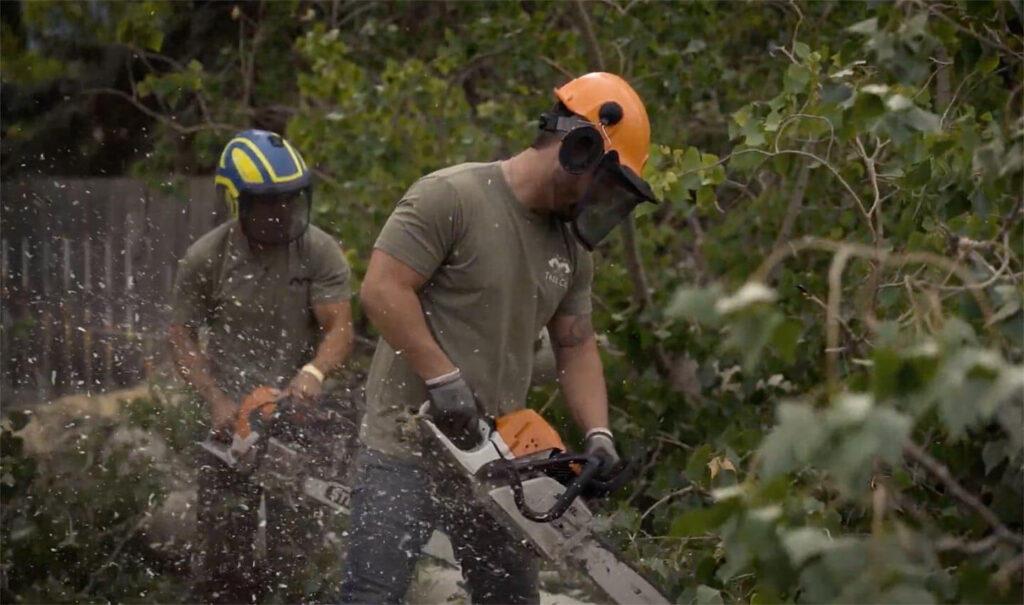
Not every problem tree needs to come down. A healthy tree with a few dead branches or minor structural issues is a trimming job. We remove the hazard, improve the structure, and the tree goes into winter in better shape.
But some trees have reached the point where removal is the right call — and fall is actually one of the best times to do it. The ground is still workable, the canopy is lighter without leaves, and you’re not scrambling after storm damage has already forced the issue. Emergency removals after a Utah winter storm are more expensive, more disruptive, and harder to schedule than a planned fall removal.
If a tree is more than 50% dead, leaning toward a structure, showing significant root damage, or has a trunk compromised by decay, removal is almost always the more responsible option. We’ll always tell you straight.
Don’t Wait for the Storm to Tell You
The trees that fail in January didn’t become hazards in January. The warning signs were there in October — they just went unnoticed.
A fall assessment from a certified arborist takes less than an hour for most properties and gives you a clear picture of what you’re working with heading into winter. Whether the answer is a trim, a removal, or nothing at all — you’ll know.
Utah Tree Co. serves homeowners across Salt Lake and Utah Counties, including Sandy, Draper, Lehi, South Jordan, American Fork, Alpine, Holladay, Murray, Provo, and the greater Wasatch Front. We’re veteran-owned, ISA-certified, and we don’t use subcontractors — the crew that shows up is our crew.
If you want flexible payment options, we offer financing through Wisetack — apply in seconds with no impact to your credit score.